
01
AI in education
Helping schools, departments, and individual instructors integrate generative AI into curriculum, assessment, and day-to-day teaching practice.
Builder of Rocketproof
Professor · AI educator · Instructional technologist · Geospatial scientist · Emergency management professional
Dr. Fisher helps educators, organizations, and professionals understand and apply artificial intelligence in practical, responsible, and human-centered ways.
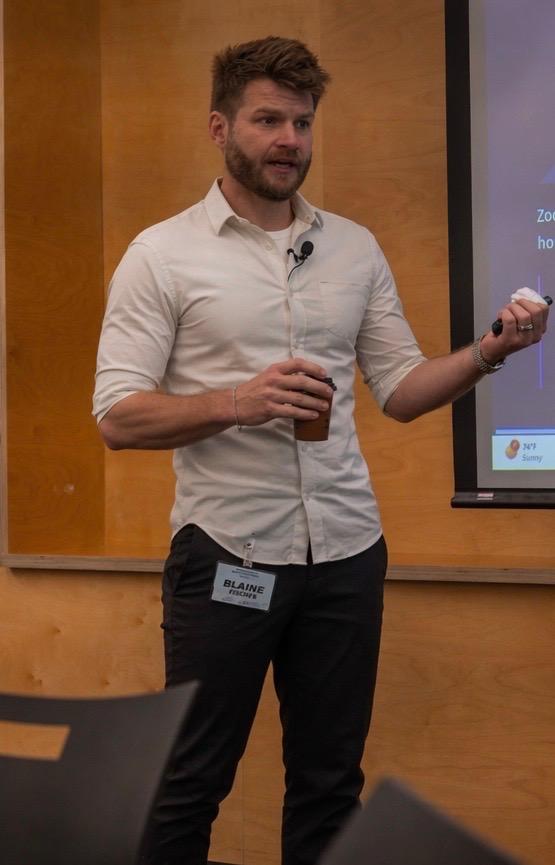
Dr. Blaine Fisher is a professor, instructional technologist, AI educator, geospatial scientist, and emergency management professional whose work sits at the intersection of emerging technology, higher education, risk, and applied research. At Tulane University, he works with faculty, staff, and academic leaders to make complex technologies understandable, practical, and useful in real teaching and learning environments.
His work focuses heavily on artificial intelligence in education, course design, instructional technology, faculty development, and the responsible adoption of emerging tools. He has trained thousands of faculty members through workshops, bootcamps, consultations, and professional development programs covering generative AI, prompt engineering, AI-assisted course development, AI ethics, assessment design, learning management systems, and the future of teaching and work.
Dr. Fisher is also an experienced professor in information technology, emergency management, GIS, and the ethics of technology. His academic background spans geography, anthropology, Maya archaeology, remote sensing, GIS, healthcare management, and emergency response. His research has involved geospatial analysis, LiDAR, drone-based remote sensing, coastal and wetlands research, and ancient Maya landscapes.
Before his current work in higher education and technology, Dr. Fisher served in emergency medical services, including work as a paramedic. That experience continues to shape his practical approach to technology, training, crisis decision-making, and human-centered systems.
Beyond the classroom and the university setting, Dr. Fisher is a public voice on AI education and emerging technology. He writes, speaks, and teaches about how artificial intelligence is changing learning, work, creativity, decision-making, and society. He is the author of The AI Human: Navigating a Transformed World, writes the Hooked on AI newsletter, and contributes to broader conversations around homeland security, technology ethics, education, and public preparedness.
If we teach our students right, AI makes them more human than they’ve ever been.
Each of these is a place where Dr. Fisher teaches, writes, consults, and builds. They share a common thread: technology becomes useful when it meets a real practitioner with real stakes.
Helping schools, departments, and individual instructors integrate generative AI into curriculum, assessment, and day-to-day teaching practice.
Training thousands of faculty through workshops, bootcamps, and one-on-one consultations covering AI literacy, course redesign, and professional growth.
LMS architecture, course design, multimedia integration, and accessibility: the practical engineering work behind every working online classroom.
Geospatial analysis with LiDAR, multispectral imaging, and drone-based remote sensing applied to coastal, environmental, and archaeological research.
Crisis response, public health preparedness, and disaster medical operations, drawn from years in the field as a paramedic and trainer.
Teaching the ethical, societal, and policy dimensions of emerging technologies: what they make possible, what they cost, and who decides.
Books, essays, newsletters, conference keynotes, and broadcast media on AI, education, and the future of work for both academic and public audiences.
Geospatial analysis of coastal change, wetlands resilience, and ancient cultural landscapes. Methods include LiDAR, multispectral imagery, drone-based remote sensing, GIS modeling, and least-cost path analysis. Recent work spans the Mississippi River Delta and Maya-period archaeological sites in Central America, with collaborations across consortia of universities, federal partners, and field research teams.
Author of The AI Human: Navigating a Transformed World. Writer of the Hooked on AI newsletter on practical AI literacy. Contributor to ongoing conversations in homeland security, emergency management, technology ethics, and higher-education policy through outlets including Homeland Security Today and other professional publications.
Keynote speaker, panel moderator, and workshop leader on AI in education, faculty development, and emerging-technology policy. Audiences range from university faculty and academic leadership to high-school students, industry conferences, federal-sector audiences, and broadcast media. Subject-matter contributor on AI, homeland security, and crisis communication for regional and national outlets.
Rocketproof is the assessment platform Dr. Fisher built out of years of teaching, training, and instructional-technology work. About ten minutes to set up a first assignment.