
Alternatives to Traditional Proctoring: Why Verification Beats Surveillance
Remote proctoring software damages student trust and fails to detect modern AI assistance. Here is how higher education faculty use authentic verification and structured oral defense instead.
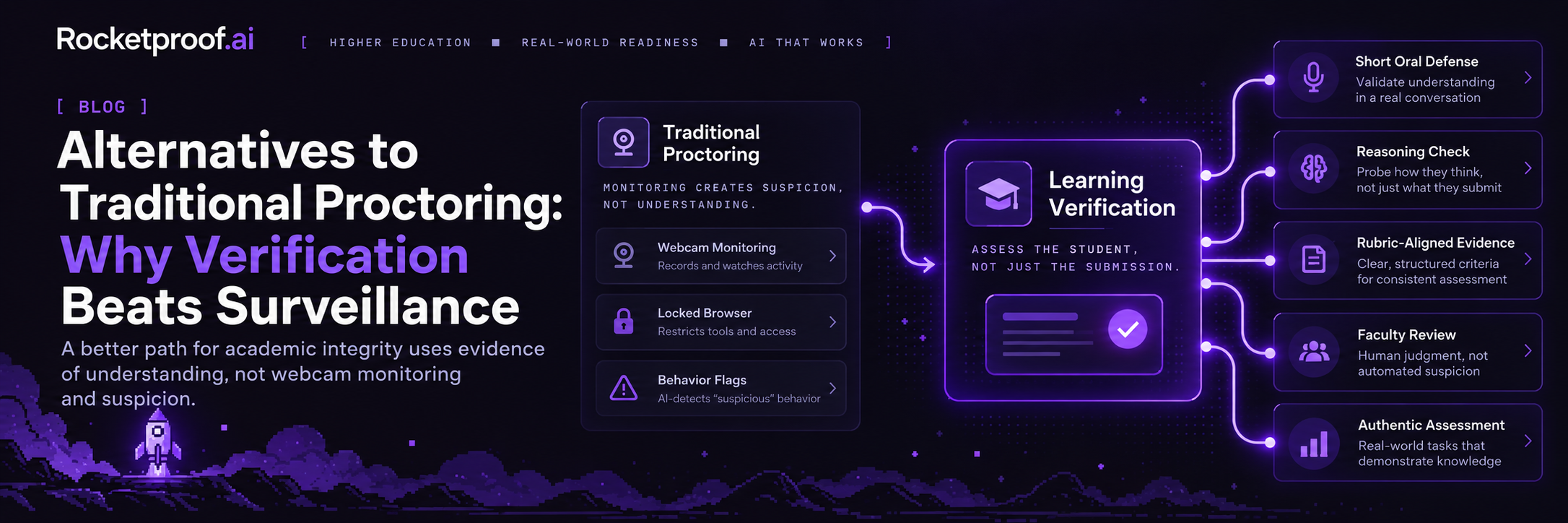
For nearly a decade, online education relied on an uneasy compromise. When institutions moved exams from lecture halls to home computers, they attempted to preserve closed-book testing by installing surveillance software on student laptops: webcam monitoring, bedroom scans, and automated facial tracking.
That approach has reached its breaking point. Automated proctoring creates accessibility barriers, generates false accusations, triggers legal privacy risks, and strains relationships between students and instructors. Even worse, proctoring software fails against generative AI. A student using a phone off-camera, a second monitor, or an earbud can query a language model without triggering an alert.
Higher education needs a better model. Instead of policing the physical environment around a screen, faculty are adopting authentic verification: evaluating whether a student can explain, apply, and defend their work.
The Structural Flaws of Remote Proctoring
The core problem with remote proctoring is a confusion between physical compliance and intellectual understanding.
Surveillance software monitors eye gaze, ambient audio, keyboard cadence, and peripheral hardware. None of those signals measure whether a student understands organic chemistry, corporate financial analysis, or constitutional law. A student can sit motionless, stare directly into a camera lens, and memorize flashcards without developing genuine analytical competence.
Four practical failures have made this surveillance model unsustainable.
1. Legal and Privacy Liabilities
In August 2022, a federal district court ruled in Ogletree v. Cleveland State University that mandatory room scans conducted before remote exams violate the Fourth Amendment, establishing that students maintain privacy expectations inside their homes. Beyond constitutional protections, student data privacy remains an institutional risk. Automated proctoring systems capture biometric markers, video feeds of private homes, and keystroke logs, creating compliance challenges under state privacy statutes and FERPA guidelines.
2. Algorithmic Bias and Equity Penalties
Automated proctoring software frequently penalizes students who deviate from a narrow technical baseline.
Audits and university research demonstrate that computer-vision algorithms struggle with darker skin tones, demanding excessive lighting or failing recognition altogether. Neurodivergent students are regularly flagged for normal behaviors like shifting posture or reading questions aloud, while students in shared apartments or rural areas face compounding technical penalties.
3. Destruction of Faculty-Student Trust and Rising Workload
Treating students as suspects turns classroom culture adversarial. Instructors bear the administrative fallout, spending weekend hours reviewing dozens of false-positive webcam flags from a single midterm to determine whether a student was checking illicit notes or simply rubbing their eyes.
4. Ineffectiveness Against Modern AI Tools
Even if an institution accepts the ethical costs of proctoring, the software fails to prevent AI-assisted misconduct.
Lockdown browsers restrict what happens on a single operating system. They cannot detect phones held off-camera, smart watches, secondary monitors, or audio feeds delivered through wireless earbuds. Colleges cannot win the surveillance arms race against consumer electronics.
The Alternative: Verification of Learning
The way out of this arms race is to change what we assess.
Surveillance asks: Did the student obey all environmental rules while producing this submission?
Verification asks: Can the student explain their reasoning, evaluate evidence, and answer spontaneous questions about their work?
When grades depend on a student's ability to discuss and defend their thinking, the incentive structure changes. A student who relies on an outside tool to generate text quickly discovers that submitting polished prose is only step one. If they cannot explain why they chose a framework or resolved a data contradiction, they cannot pass the assessment.
This approach aligns with the core philosophy of authentic assessment: assess the student, not just the submission. We explored this distinction in detail in our analysis of AI detection versus verification of learning.
Four Authentic Alternatives to Remote Proctoring
Moving away from proctoring does not mean lowering academic expectations. Authentic alternatives demand higher cognitive engagement than multiple-choice exams.
Here are four concrete assessment models that faculty are using across online and hybrid courses.
1. Asynchronous Structured Oral Defense
The oral defense (or viva voce) has been the gold standard of academic verification in graduate education for centuries. Structured oral assessment brings this practice into undergraduate and professional courses.
Students submit a written paper, lab report, case study analysis, or slide deck. Following submission, the student participates in a short, structured conversation of five to ten minutes with targeted questions grounded directly in their artifact:
- "In section three of your paper, you argued that supply chain disruptions drove 2021 inflation. What reference evidence supports that claim, and how would you answer someone pointing to monetary stimulus?"
- "Walk me through how you calculated the risk-adjusted return in your financial model. Why did you choose that discount rate?"
- "Your code solves sorting using a hash map. What happens to memory overhead if the dataset scales tenfold?"
A student who used AI to generate their paper without reading it will struggle on these follow-ups. A student who did the work can answer them naturally.
As we discussed in What Is an Oral Defense, and Why Is It Returning in the AI Era?, conversational verification restores faculty confidence without webcam surveillance. Platforms like Rocketproof support this workflow across recorded audio, live voice, and text chat.
2. Scenario-Based AI Simulations
Rather than testing whether students have memorized abstract protocols, scenario-based learning places students inside dynamic simulations where decisions produce immediate consequences:
- Healthcare and Nursing: Instead of taking a proctored quiz on clinical triage, a nursing student interacts with an AI patient displaying fluctuating symptoms. The student takes a medical history using standard frameworks like OLDCARTS or SBAR, orders lab panels, and explains their differential diagnosis.
- Business and Management: A business student sits across a virtual table from an AI procurement director pushing back on price. The student must uncover underlying interests, protect margin floors, and trade concessions thoughtfully.
- Emergency Management: A student acts as an incident commander during a cascading flood scenario, balancing resource allocation against weather reports under Incident Command System (ICS) protocols.
Because the AI persona responds adaptively to student choices, static answer keys and chatbot cut-and-pastes do not work. You can explore how faculty configure these experiences on our AI simulations page.
3. Presentation and Project Defenses
Many online courses assign capstones, client briefings, marketing plans, or engineering project decks. In traditional setups, students submit a PDF or record a rehearsed video presentation.
A presentation defense pairs that artifact with an adaptive question session. The student uploads their slide deck. The system extracts slide structure, visual figures, and speaker notes, then initiates an interactive follow-up:
- "On slide six, you propose shifting 40% of the marketing budget into creator partnerships. What metrics will you track during the first ninety days to determine if that spend is performing?"
- "Your architecture diagram shows three microservices sharing a common database. Why did you choose that pattern over an event-driven architecture, and what failure modes does it create?"
This turns static presentations into dynamic demonstrations of competence.
4. Process Reflections and AI-Use Defense
In courses where faculty permit students to use generative AI for research or drafting, assessment should evaluate how students verify those tools. Students submit the final deliverable, a workflow log documenting prompts and factual corrections, and a short verbal reflection defending their choices: "The model suggested an approach based on a 2018 precedent, but when I checked the citation, I found the decision had been overturned on appeal. I discarded that section and rebuilt the argument using current statutory guidelines." This approach rewards critical verification and source criticism, transforming AI from a cheating vector into an object of analytical inquiry.
Solving the Scalability Problem for Online Faculty
When instructional designers suggest oral exams or simulations, faculty often worry about time. Multiple-choice exams dominate online education because they scale effortlessly: an instructor teaching two hundred students can administer a quiz in Canvas or Blackboard with zero grading hours. Conducting two hundred live fifteen-minute Zoom interviews would require fifty hours of calls, an impossible burden for faculty.
Modern educational platforms resolve this bottleneck. In How Can Oral Assessment Work in a Class of 100 Students?, we outlined the mathematics of asynchronous defense review.
Students complete structured oral defenses asynchronously on their own schedule. The platform processes the audio, indexes the transcript, aligns responses to the rubric, and highlights key evidence quotes. When grading, the instructor opens a unified console, reviews the submission alongside the defense transcript, listens to key audio clips, calibrates rubric scores, and approves the grade.
A rigorous oral verification that would have taken twenty minutes live takes three to four minutes of asynchronous review. In a course of sixty students, that translates to three hours of focused grading instead of fifteen hours of calendar management. Crucially, human faculty retain complete authority: AI tools transcribe responses and suggest rubric baselines, but the professor remains the sole arbiter of academic credit.
How to Transition an Online Course Away from Proctoring
A phased approach ensures a smooth transition away from proctoring software.
Step 1: Replace One High-Stakes Proctored Exam
Identify your most stressful assessment, typically a proctored midterm or final exam. Replace it with a two-stage authentic assignment: a written or technical deliverable followed by a structured oral defense. Explain the rationale clearly: this course values your ability to think through problems and explain your reasoning, without requiring surveillance software.
Step 2: Build Low-Stakes Practice into Early Modules
Introduce an ungraded rehearsal during week two. Ask students to record a three-minute audio explanation of a single reading concept. This familiarizes them with the interface, normalizes speaking aloud, and lowers test anxiety before graded milestones arrive.
Step 3: Align Rubrics to Explanation and Reasoning
Update rubrics to reward conceptual ownership: depth of explanation, handling counterarguments, source awareness, and clarity of thought rather than factual recall.
Step 4: Ensure Accessibility and Universal Design
Under Universal Design for Learning principles, authentic assessment must accommodate diverse needs. For students with speech impairments or anxiety accommodations, ensure your platform supports text-based response options as an equitable alternative to spoken voice. Rocketproof allows instructors to configure text-based conversational defenses or extend timers without compromising adaptive questioning.
Frequently Asked Questions
Does removing proctoring lead to increased academic dishonesty?
No. University research indicates that high-stakes recall exams create the primary motivation for misconduct. When assessments require students to explain their reasoning, the utility of shortcuts drops precipitously. A student cannot fake comprehension during an adaptive follow-up conversation.
How do oral defenses work with institutional LMS platforms?
Modern assessment platforms integrate directly into standard Learning Management Systems such as Canvas, Blackboard, D2L Brightspace, and Moodle using LTI 1.3 Advantage standards. Students launch the defense directly from their LMS assignment link, and finalized faculty grades synchronize directly to the gradebook via Assignment and Grade Services (AGS).
How does this approach handle students who experience speaking anxiety?
Authentic assessment verifies understanding, not theatrical public speaking. Because asynchronous defenses take place in private settings without peers, performance pressure is much lower than in live presentations. Flexible platforms also allow instructors to provide text-chat alternatives, untimed pauses, or practice attempts for students with accommodations.
What about courses that require memorization of foundational facts?
Foundational terminology is best evaluated through frequent, low-stakes formative quizzes with randomized question pools. Reserve higher-stakes evaluations for authentic verification, where students apply those concepts to realistic scenarios or defend original work.
Moving Forward
Webcam surveillance in higher education attempted to force twentieth-century testing conventions onto twenty-first-century online classrooms. Higher education does not need smarter surveillance tools to watch students during tests. It needs better assessments that make surveillance irrelevant.
By shifting from surveillance to verification, colleges protect student privacy, reduce institutional legal risk, and build assessment structures that remain durable no matter what consumer AI tools emerge next. When students know they will be asked to explain their work, they focus on learning the material, which is where their attention belonged all along.
If you are interested in exploring how structured oral assessment and scenario-based simulations work in practice, explore our oral exams overview or request access to an interactive demo.
See Rocketproof in action
Explore the interactive demo as a student and an instructor, or request a pilot for your department.