
AI Negotiation Simulations for Business Courses
How business faculty use AI personas to put students across the table from a skeptical buyer or an angry client, then grade the negotiation from the transcript, not a self-report.
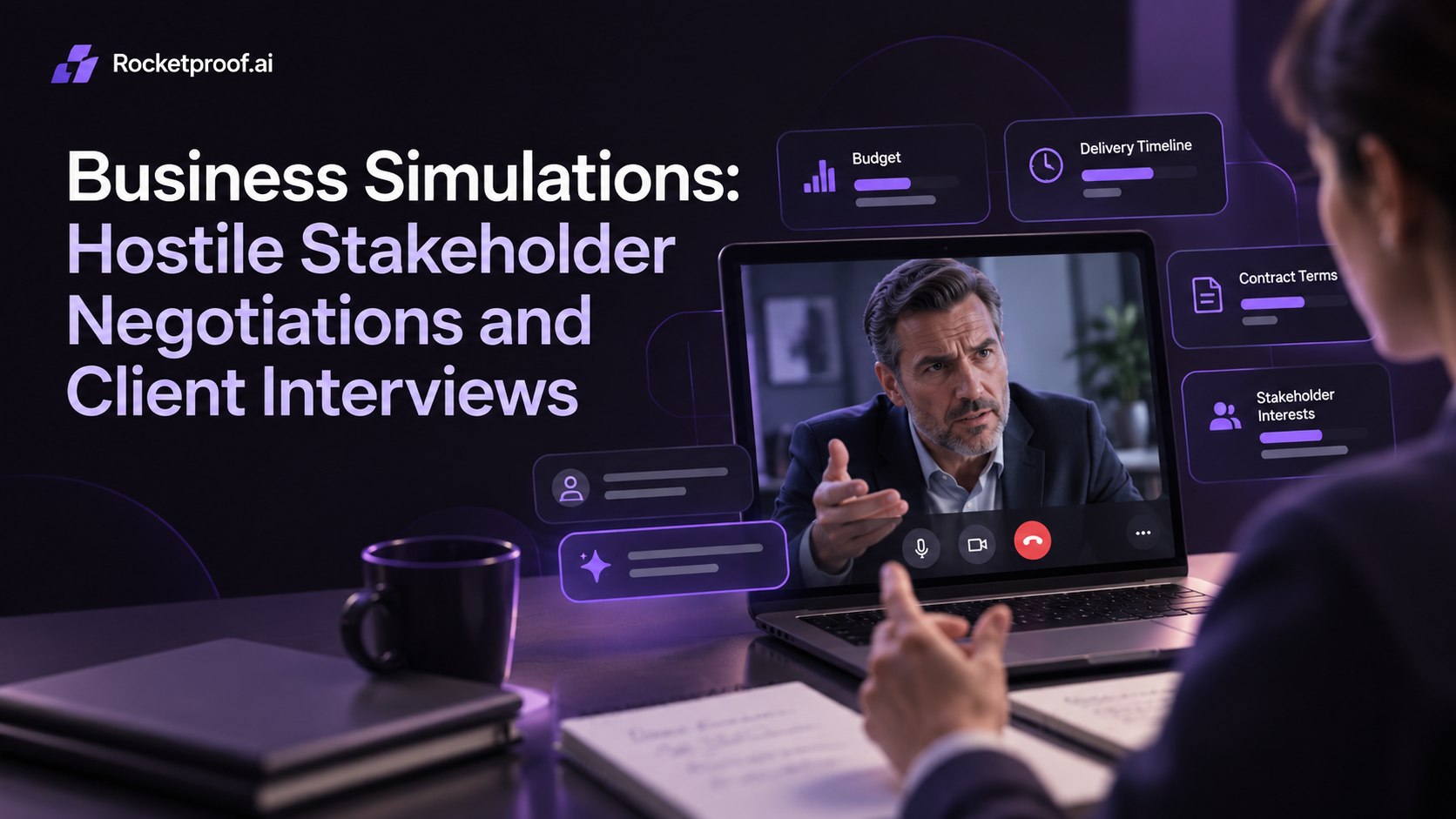
Every negotiation course has the same awkward moment. The class has read the chapter on BATNA, can define anchoring, and can explain the difference between positional and interest-based bargaining. Then you put two students in a room, hand each a confidential sheet, and what you get is usually one of three things: a quick split-the-difference deal, a pair who start chatting about their weekend, or a student who wins by being rude.
None of that is the students' fault. Peer role-play is a hard format to run well. Partners drop character, go easy on each other, or simply don't know how a procurement VP at a mid-size manufacturer actually pushes back. And you, the instructor, can only listen in on one pair at a time.
An AI counterpart doesn't solve everything, but it fixes the specific problems above. The persona stays in character. It is as tough as you configured it. And because it is a recorded conversation, you can read exactly what happened in all thirty negotiations, not the thirty summaries.
Where case studies and peer exercises run out
Case studies are good at teaching students to analyze a decision after the fact. They are less good at the thing a manager does in the moment, which is to hear "we'll need 12% off or we walk," decide whether it is a bluff, and respond before the pause gets uncomfortable.
Peer role-play gets closer, but there is a grading problem. When you assess a live exercise, you are usually assessing the written reflection afterward. Students describe what they agreed to. They rarely describe the moment they caved on price in the second minute because the other side sounded annoyed. The deal terms are visible. The behavior that produced them is not.
An example: the renewal conversation
Here is a scenario of the type business faculty build in Rocketproof.
The AI plays Elena Vance, VP of Global Procurement at a mid-size electronics manufacturer. She has a mandate from her CFO to cut component costs by 12% this year. She has been burned twice by late deliveries from logistics vendors and is particularly sensitive to anything that threatens her assembly line schedule. She has a quote from a competitor, and she will mention it, but she will not show it.
The student plays the account lead for a logistics vendor trying to renew a three-year contract.
A few things make this useful rather than theatrical:
Elena has a walk-away point. The instructor sets it. Below a certain price floor and above a certain delivery guarantee, she signs. Otherwise she doesn't. That gives the exercise a real outcome instead of a vague feeling of having "done fine."
She responds to substance. If the student says "we're committed to partnership," she is unmoved. If the student offers a specific service-level guarantee with a penalty clause, she engages. If the student drops the price by 8% without asking for anything in return, she notices and asks for more.
She remembers. If the student promised 98% on-time delivery in minute four, Elena brings it up in minute fourteen when the student quietly walks it back to 95%.
A sample exchange might go like this:
Student: We can offer you a 6% reduction if you sign for three years.
Elena: Six percent doesn't close the gap, and it doesn't solve my real problem. If your warehouse automation goes down again, who pays for my line sitting idle?
That is the moment the instructor wants to see: does the student answer the delivery risk, or keep talking about price?
Setting up a negotiation
Faculty don't need to write prompts. The Assignment Creator drafts the scenario from a description, and the instructor refines it. Most strong negotiation cases cover the following.
The commercial facts. Contract value, term, market conditions, and what each side could get elsewhere. If you want students to practice reservation points properly, give the AI party a real BATNA and a number below which it will walk.
The persona's style. Is the counterpart analytical, impatient, warm but immovable? Different styles surface different weaknesses. A brusque buyer exposes students who fold under pressure. A friendly one exposes students who mistake rapport for agreement.
The student's targets. Margin floor, minimum contract length, the service terms they must protect. These turn "did they do well" into something checkable.
The rubric. Reasonable criteria for a negotiation include quality of preparation, how well interests were uncovered, whether concessions were traded rather than given away, composure when challenged, and accuracy of any numbers the student cited. If your course follows the principled negotiation framework from Fisher and Ury's Getting to Yes, you can write criteria for separating people from the problem, focusing on interests, and generating options. Rocketproof drafts scores against your rubric with references to specific moments, and you review and finalize them.
You can also run client interviews with the same setup. A discovery call with a vague, defensive client, where the student's job is to uncover the real requirement, is a common one in consulting and product courses.
Why the transcript matters
The biggest practical gain is not the AI persona. It is the record.
With a full recording and timestamped transcript, the debrief stops being a recollection contest. You can ask students questions like:
- You offered a discount at 03:12. What did you get in return?
- Elena said her real concern was delivery. When did you first address it?
- Where did you decide to stop asking questions and start pitching?
Students tend to find their own patterns quickly once they can see them. Some concede early and often. Some ask no questions for the first ten minutes. Some talk through every silence. Those habits are hard to notice from the inside and easy to spot on a page.
Students can also review the session with the Study Coach before the debrief, to look at where the rubric says they lost points and what they would do differently.
A starter rubric you can adapt
Rubrics for negotiation tend to fail in one of two ways: they're so vague that every student gets a B, or so detailed that nobody can apply them. Five criteria, each scored on a short scale, is usually enough.
- Preparation. Did the student show they understood the counterpart's situation and their own limits before they started?
- Interests over positions. Did they ask why Elena wanted the number she wanted, or only argue about the number?
- Trading concessions. Every concession should have been tied to something in return. Count the ones that weren't.
- Accuracy. Were the figures the student cited correct and consistent from the beginning of the call to the end?
- Composure. What happened to their tone and pace when the counterpart pushed back or threatened to leave?
Write one sentence for what a strong, adequate, and weak performance looks like for each criterion, and share the rubric with students before they practice. They will use it to coach themselves.
Practice before it counts
Negotiation improves with repetition, and a single graded attempt is a poor way to teach it. Faculty can set the same scenario as ungraded practice first, so students can try an aggressive opening, a collaborative one, or a bad one deliberately to see what happens. Practice transcripts stay with the student. Faculty can require some practice before the graded round opens.
When a student runs the same scenario three times and the third negotiation is clearly better than the first, that growth is visible in their own transcripts. That is hard to get from a single in-class exercise.
Limits to keep in mind
An AI persona is not a human counterpart, and it will not read the room like an experienced buyer. It can be too consistent, and it can't replicate the social pressure of a peer watching you. We'd suggest treating it as the practice layer: use it for the first several repetitions, and keep a live human negotiation as the capstone. Also try each scenario yourself before assigning it, so you know how Elena will react to the obvious moves.
Try one
Pick a negotiation your course already uses. Write the counterpart's walk-away number on a sticky note, along with the one fact they'll never volunteer. Then build it in the AI simulation platform and run it yourself before students do. For more on the discipline, see the business education solutions page, and for a similar approach in a different field, read about witness examination drills in law school.
Questions business faculty ask
Can the AI counterpart actually be tough? Yes, if you tell it to be. Give it a real walk-away number, a competing offer, and a temperament. The most common mistake is writing a counterpart who is too agreeable, so test yours before students do.
Is this only for negotiation courses? No. The same setup works for sales calls, client discovery interviews, performance reviews, board pitches, and supplier disputes. Anything where a student has to respond to a person who is not following the script.
How do I stop students from gaming it? Students can try tricks, like repeating the same offer, and the persona should respond the way a real counterpart would. Grading on the transcript rather than the final deal also helps, because a lucky deal and a well-run negotiation read very differently on the page.
Do students get the same scenario? Usually, which makes grading fairer. If you want variation, build two or three versions with different personalities and assign them randomly.
What does a student see afterward? The recording, the transcript, and the rubric feedback you release. Many instructors have students write a short reflection that quotes their own transcript.
See Rocketproof in action
Explore the interactive demo as a student and an instructor, or request a pilot for your department.