
How to Use AI Simulations as Assignments in College Courses
AI simulations can turn traditional college assignments into interactive experiences where students interview, negotiate, diagnose, respond, and make decisions in realistic scenarios. This guide explains how faculty can design AI simulation assignments that connect dynamic role-play to clear learning objectives, meaningful practice, and authentic assessment.
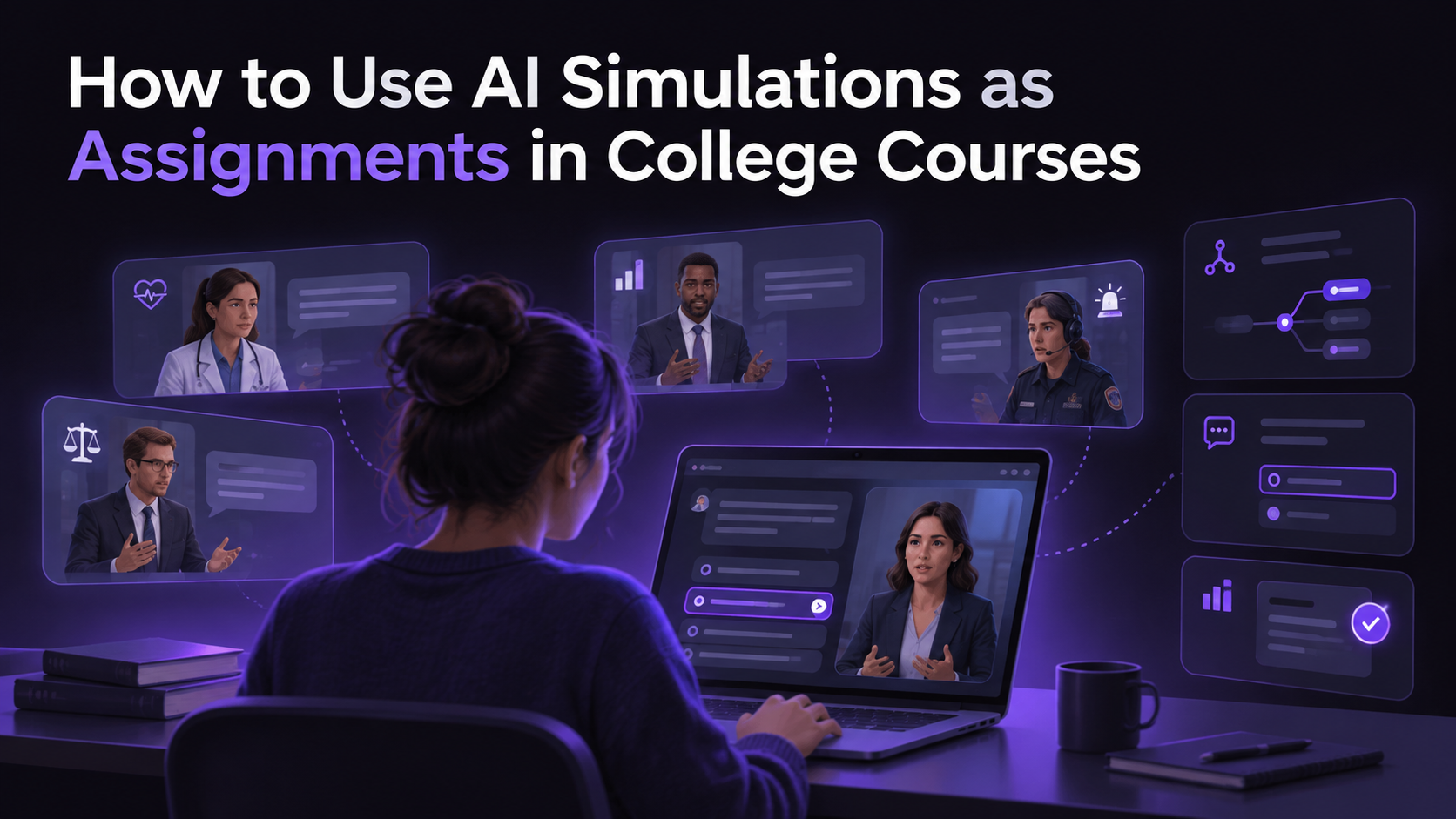
For most of my career in education, when I wanted students to apply what they were learning, I had a fairly familiar set of options. I could give them a case study, ask them to analyze a scenario, have them write a response, organize a classroom role-play, or build some kind of project around a real-world problem.
All of those approaches can work, and I still use them. What has become much more interesting with generative AI is that the scenario itself can now respond to the student.
Instead of giving students a written case about an angry client and asking them to explain how they would respond, I can put them into a conversation with that client. Instead of asking a nursing student to write about the questions they would ask a patient, I can let them interview an AI patient who reveals information depending on what they ask. Instead of asking an emergency management student to describe how they would handle a developing crisis, I can let the crisis change as the student makes decisions.
That changes the assignment in a meaningful way. The student is no longer describing what they might do from a distance. They have to act inside the situation.
I think AI simulations in education could become one of the more useful applications of generative AI in higher education for exactly that reason. The technology stops being primarily a tool for producing content and becomes part of the environment in which the student has to think, communicate, make decisions, and perform.
Used well, an AI simulation can turn a traditional assignment into an experience. The hard part is making sure that experience is actually educational.
What is an AI simulation assignment?
An AI simulation assignment places the student inside a scenario and uses artificial intelligence to respond dynamically to what the student does.
The student might be interviewing a patient, negotiating with a business partner, responding to a parent, questioning a witness, managing an emergency, counseling an employee, defending a proposal, or working through an ethical dilemma. The AI takes on the other role in that situation and responds according to the conditions the instructor has defined.
Consider a traditional business assignment:
Read the following case about a contract negotiation. Write 750 words explaining how you would approach the negotiation.
There is nothing inherently wrong with that assignment. A student can demonstrate useful analytical skills through the written response. But an AI-powered version could put the student directly into the negotiation.
The AI might play the procurement director for a company considering the student's proposal. The director has a budget limit, several concerns that are initially hidden from the student, competing offers from other vendors, and instructions to push back aggressively on certain terms.
Now the student has to conduct the negotiation.
If the student immediately offers a large discount, the AI reacts to that choice. If the student asks good questions and discovers that delivery time matters more than price, the conversation can move in another direction. If the student makes an unrealistic promise, the AI can challenge it.
The assignment has moved from "Tell me what you would do" to "Show me what you would do."
That shift is what makes simulation interesting as a form of assessment.
Why AI makes simulation more practical
Simulation itself is not new to education. Nursing and medical education have used simulations for years. Business schools use negotiation exercises and case competitions. Teacher preparation programs conduct mock parent conferences. Law schools use moot courts and mock trials. Emergency management programs run tabletop exercises. Language courses use conversational practice.
These approaches are valuable because students have to use knowledge under conditions that resemble the situations in which that knowledge will eventually matter.
The problem has always been scale.
A good role-play usually requires another person. Someone has to play the patient, client, customer, parent, witness, manager, employee, or stakeholder. That person needs to understand the scenario, respond consistently, and know what information to reveal.
Doing that once in a classroom can be manageable. Doing it individually for 80 students is another matter.
Generative AI changes that equation because an AI persona can participate in the simulation repeatedly while following the same underlying scenario, character, and instructional boundaries. That opens the door to using simulation in places where it would previously have been too difficult, too time-consuming, or too expensive to run with every student.
Simulation no longer has to be reserved for specialized labs, small seminars, or the occasional classroom exercise. It can become part of the regular assignment design toolkit.
Start with the learning objective, not the AI
The easiest mistake to make is starting with the technology.
"I want to create an AI simulation" is an interesting idea, but it is not yet an instructional goal. Before building anything, I would ask the same question I would ask when designing any other assignment:
What should the student be able to demonstrate by the end of this experience?
Suppose I am teaching emergency management. I might want students to demonstrate that they can prioritize limited resources, communicate with multiple stakeholders, recognize cascading infrastructure failures, and adjust a response plan as conditions change.
Now I have something worth simulating.
A student could be placed in the role of an emergency manager responding to a hurricane. The simulation might begin with flooding and widespread power outages. As the conversation progresses, additional problems emerge. A hospital loses backup power. A major evacuation route becomes impassable. A shelter reaches capacity. Incorrect information starts spreading on social media.
The student's decisions affect what happens next.
The AI is useful because it makes the environment responsive, but the learning objective still determines what the simulation is for.
Give the AI a role, not just a prompt
A good educational simulation usually needs more than a sentence telling the AI what to do. The AI needs a character or an operational role with enough structure to behave consistently.
If the student is conducting a patient interview, for example, the AI needs to know who that patient is. That includes the patient's age, symptoms, medical history, emotional state, what information they know, what they do not know, and what they should reveal only if the student asks the right questions.
The same principle applies outside healthcare.
An AI client in a business course might have a budget, competing priorities, internal political pressures, and a point beyond which they will walk away from a negotiation. An AI witness in a legal studies course might remember some details clearly, be uncertain about others, become defensive when challenged, and possess important information that only emerges through careful questioning. An AI parent in a teacher education course might be frustrated because their child is struggling academically and feel that the school has failed to communicate effectively.
Those details create something for the student to discover and respond to. Without them, the "simulation" can quickly collapse into a generic chatbot conversation where the AI is simply waiting for the student to say something.
Decide what the AI knows and what the student has to discover
One of the most useful design principles for AI simulations is information asymmetry.
The AI should often know something the student does not. That creates a reason for the student to ask questions, listen carefully, investigate, and make decisions based on incomplete information.
Imagine a nursing student interviewing an AI patient who reports feeling dizzy and weak. The instructor could configure the scenario so the patient is taking a medication that interacts with another drug, but the patient does not volunteer that information unless asked about medications.
Now the quality of the student's questioning matters.
A business negotiation could work the same way. The other party may appear primarily concerned about price, while their real priority is delivery speed. Students who spend the entire conversation arguing about price may never discover the information that could lead to a better agreement.
An emergency scenario could contain a vulnerable facility that has not yet failed. Students who ask the right questions about infrastructure dependencies may identify the risk early enough to do something about it.
The simulation becomes much more educational when students have to uncover information rather than simply respond to information that has already been handed to them.
Let student decisions change what happens
A simulation becomes more useful when choices have consequences.
In a traditional case study, the situation is usually fixed. Students read what happened and analyze it afterward. An AI simulation can evolve while they are inside it.
Suppose a student is managing a public relations crisis. If the student delays communicating with the public, misinformation may spread. If the student releases information before verifying it, the organization may have to correct the statement later. If the student communicates clearly and quickly, the situation develops differently.
That does not mean the AI should create random chaos. Too much randomness can make an assignment less useful, especially if students receive experiences that are so different they become difficult to compare fairly.
The instructor should still define the important conditions, milestones, and consequences in advance. AI adds flexibility inside those boundaries.
That balance is important. The simulation needs enough freedom to respond naturally to the student while remaining structured enough to assess the learning objectives.
Build pressure carefully
Real professional situations rarely happen under perfect conditions. A patient may be frightened. A client may be impatient. A parent may be angry. A manager may interrupt. Information may be incomplete. Time may matter.
AI simulations can reproduce some of that pressure in a controlled environment, and there is educational value in doing so because knowing something and using it under pressure are different skills.
A student may understand the principles of conflict resolution perfectly when answering a multiple-choice question and still struggle to apply those principles when an AI employee says, "I don't think you're listening to me."
A student may know the Incident Command System organizational structure and still have difficulty deciding what to prioritize when several problems arrive at once.
The pressure should serve the learning objective. Making an AI persona difficult, hostile, or emotional simply to make the assignment harder usually adds very little. If the frustration, urgency, ambiguity, or pushback reflects the kind of situation the student is learning to handle, then it becomes part of the instruction.
Give students a chance to practice before grading them
One of the things I particularly like about simulations is that failure can become part of the learning process, as long as every failure does not immediately become a grade.
If students are learning how to conduct a difficult interview, negotiate an agreement, manage an emergency, or communicate with a patient, there is real educational value in letting them make a poor decision and see what happens.
Perhaps the negotiation collapses. Perhaps the patient becomes frustrated because the student keeps interrupting. Perhaps the student's crisis communication strategy creates another problem.
That can be much more memorable than reading a paragraph explaining what they should have done.
I would rather have a student experience that consequence in a simulation, think about why it happened, and try again. This is why AI simulation assignments can work particularly well when they include both practice and assessment.
Students can rehearse privately, experiment with different approaches, and learn the dynamics of the situation. Once they are ready, they complete the version that counts toward the course grade.
Rocketproof supports that distinction directly. Instructors can create private practice simulations that students can repeat without those attempts entering the gradebook, then require one or more rehearsals before the graded simulation becomes available.
That structure gives students room to learn through the simulation before asking the simulation to serve as evidence of what they have learned.
Think carefully about what you are actually grading
An AI simulation creates a lot of activity, but activity by itself is not evidence of learning. The rubric still needs to connect directly to what the student was supposed to demonstrate.
If the student is conducting a clinical interview, the instructor might assess whether the student identifies relevant symptoms, asks appropriate follow-up questions, recognizes risk factors, communicates clearly, and recommends an appropriate next step.
A negotiation assignment might evaluate preparation, questioning, listening, use of evidence, adaptability, communication, and the reasoning behind the final agreement. An emergency management simulation might evaluate situational awareness, prioritization, resource allocation, communication, adaptation, and justification of decisions.
The final outcome should not necessarily determine the grade.
A student could "win" a negotiation while using a poor process. Another student could make a defensible decision during an emergency scenario and still experience a negative outcome because the situation contains uncertainty.
What matters is the quality of the student's performance and reasoning.
Ask the student to explain what happened afterward
One of the best additions to a simulation assignment is a short debrief.
After the scenario ends, ask the student what they think happened. What decision had the greatest effect on the outcome? What information did they miss initially? What would they do differently? At what point did their strategy change? What evidence influenced that decision?
This gives the student an opportunity to move from experience to reflection, and it gives the instructor another form of evidence.
Sometimes a student makes a mistake during a simulation and immediately recognizes it. That tells me something different from a student who makes the same mistake and still does not understand why it was a problem.
A simulation shows me what the student did. The debrief helps me see what the student understood about what they did.
AI simulations can work across disciplines
It is easy to associate simulation with medicine or emergency management, but the same basic structure works in many fields.
A nursing student can interview an AI patient presenting with chest pain and determine what information is clinically significant. A business student can negotiate with an AI supplier who has conflicting priorities. A law student can question an AI witness whose testimony contains inconsistencies. A teacher candidate can conduct a parent conference with an AI parent who is frustrated about a child's academic performance.
A social work student can practice an intake interview. A public administration student can brief an AI mayor during a developing emergency. A communications student can respond to aggressive questions during a simulated press conference. A language student can enter a restaurant, hotel, workplace, or travel scenario and conduct the entire interaction in the target language.
The same idea can extend further. A cybersecurity student could respond to an unfolding incident while an AI stakeholder provides new information. A history student could interview a carefully bounded historical persona and then critique the limitations of that simulation against primary sources. A philosophy student could defend an ethical position while an AI interlocutor challenges the consistency of the argument.
The technology is similar in each example, but the educational purpose is completely different.
That is why I find it more useful to think of AI simulation as an assignment format rather than a particular type of assignment.
A simple framework for designing an AI simulation assignment
When I am thinking through one of these activities, I find it useful to define a few things before worrying too much about the technical implementation.
1. Define what the student is supposed to demonstrate
Write the learning objective first. Be specific enough that you could recognize successful performance when you see it.
2. Define the student's role
Who is the student in this situation? Are they a nurse, manager, teacher, attorney, emergency manager, consultant, researcher, engineer, counselor, or something else?
The role determines what authority, information, and responsibilities the student should have.
3. Define the AI's role
Who or what is the student interacting with?
Give that character goals, motivations, knowledge, constraints, and an appropriate emotional state.
4. Define the starting conditions
What does the student know when the simulation begins?
That information might come from a case brief, patient chart, memo, email, dataset, incident report, or some other source.
5. Define the hidden information
What does the AI know that the student needs to uncover?
This is often where the most interesting reasoning happens.
6. Define the important decision points
What decisions should matter during the experience?
Think about what should happen when the student makes a strong decision, a weak decision, or fails to act.
7. Define the boundaries
What should the AI never do?
An AI patient should not suddenly become the instructor and tell the student the correct diagnosis. A negotiation partner should not explain the learning objective. A witness should not conveniently volunteer every important fact.
The persona needs to remain inside the simulation.
8. Define the evidence
What will the instructor review afterward?
That might include the transcript, recording, student decisions, rubric evidence, final outcome, and post-simulation reflection.
9. Define the rubric
Decide which parts of the student's performance actually count before students begin the activity. Trying to decide afterward what an interesting conversation should be worth is much harder.
10. Decide whether students should practice first
For skill development, the answer will often be yes.
Students learn simulations partly by experiencing them. Giving them a low-stakes opportunity to understand the environment can produce a much better assessment of the skill you actually care about.
What AI should do in the assessment
There is another distinction that matters to me.
AI can make the simulation practical. It can play the persona, respond dynamically, introduce scenario developments, ask follow-up questions, transcribe the interaction, and help organize evidence from the session.
I would be much more cautious about allowing it to make the final academic decision.
In Rocketproof, for example, AI can draft rubric evaluations and connect those suggestions to evidence from the student's interaction. The instructor reviews that evidence, changes scores or feedback when appropriate, and decides what grade gets released.
That division of labor makes sense to me.
AI is particularly useful for handling the parts of simulation that are difficult to scale. It can play the patient 100 times. It can conduct 100 conversations. It can transcribe those conversations and help identify portions that are relevant to the rubric.
The faculty member still provides academic judgment.
How Rocketproof approaches AI simulation assignments
This is one of the reasons Rocketproof has expanded beyond its original focus on oral defense.
The same basic idea behind authentic assessment applies to simulation. Students should have opportunities to demonstrate what they can do, especially when the learning outcome involves judgment, communication, reasoning, or performance.
Instructors can build scenario-based and role-play assignments in Rocketproof and define the environment, AI persona, objectives, milestones, hidden information, and evaluation criteria.
Students can interact through typed conversation, recorded spoken responses, or real-time live voice depending on the assignment.
The AI persona stays within the role defined by the instructor. A simulated patient behaves like the patient. A witness behaves like the witness. A difficult stakeholder behaves like the stakeholder.
The instructor can also create branching scenarios in which the situation changes in response to student decisions.
Afterward, the interaction becomes reviewable evidence. The instructor can examine the transcript and recording, review the student's decisions and responses, see AI-drafted rubric suggestions tied to evidence from the session, make adjustments, and finalize the evaluation.
The same simulation can also be configured for private practice so students have the opportunity to rehearse before completing a graded attempt.
For me, that combination is where AI simulation becomes much more than an interesting classroom demonstration. It becomes an actual assignment.
Start with one situation you wish students could experience
Faculty do not need to convert an entire course into simulations. I would start much smaller.
Think about one situation you currently have to describe to students because you cannot easily let every student experience it.
Maybe you teach nursing and wish every student could interview the same complicated patient. Maybe you teach business and want every student to conduct a negotiation rather than write about one. Maybe you teach education and want teacher candidates to practice difficult parent conversations before encountering them professionally.
Maybe you teach emergency management and want students to make decisions while the situation changes around them. Maybe you teach law and want students to question a witness instead of simply reading testimony.
That is probably your first AI simulation assignment.
Write down who the student is, who they need to interact with, what they need to accomplish, what the other character knows, what could go wrong, and what successful performance would look like.
At that point, you already have most of the instructional design. AI simply gives the other side of the scenario the ability to answer back.
AI assignments should ask students to do something meaningful
Generative AI has created understandable anxiety around assignments because it is remarkably good at producing many of the things we traditionally ask students to submit.
The same technology can also push assignment design in a more interesting direction.
Students can question, negotiate, diagnose, prioritize, explain, respond, adapt, defend, and reflect. They can be asked to use what they know while the situation changes around them.
Those are difficult skills to evaluate through a static submission alone.
I think that is one of the more promising directions for AI-powered assignments in higher education. AI can help create experiences that previously required considerable time, staffing, coordination, or specialized facilities and make some of those experiences available to far more students.
The value of an AI simulation comes from what the student has to do once the simulation begins.
If the experience asks the student to apply knowledge, make decisions, deal with consequences, reflect on those decisions, and demonstrate understanding, then AI is doing something genuinely useful for education.
And that is a much more interesting use of the technology than asking it to write another paper.
Rocketproof.ai helps faculty create AI-powered simulations, role-play assignments, and authentic assessments in which students demonstrate what they know through conversation and performance. Instructors can build scenarios with AI personas, branching decisions, private practice, live voice interaction, structured rubrics, and faculty-controlled evaluation.
Assess the student, not just the submission.
See Rocketproof in action
Explore the interactive demo as a student and an instructor, or request a pilot for your department.