
Crisis Simulation for Emergency Management Programs
How emergency management faculty build branching AI crisis scenarios where students give spoken orders, get incomplete information, and live with the consequences of their decisions.
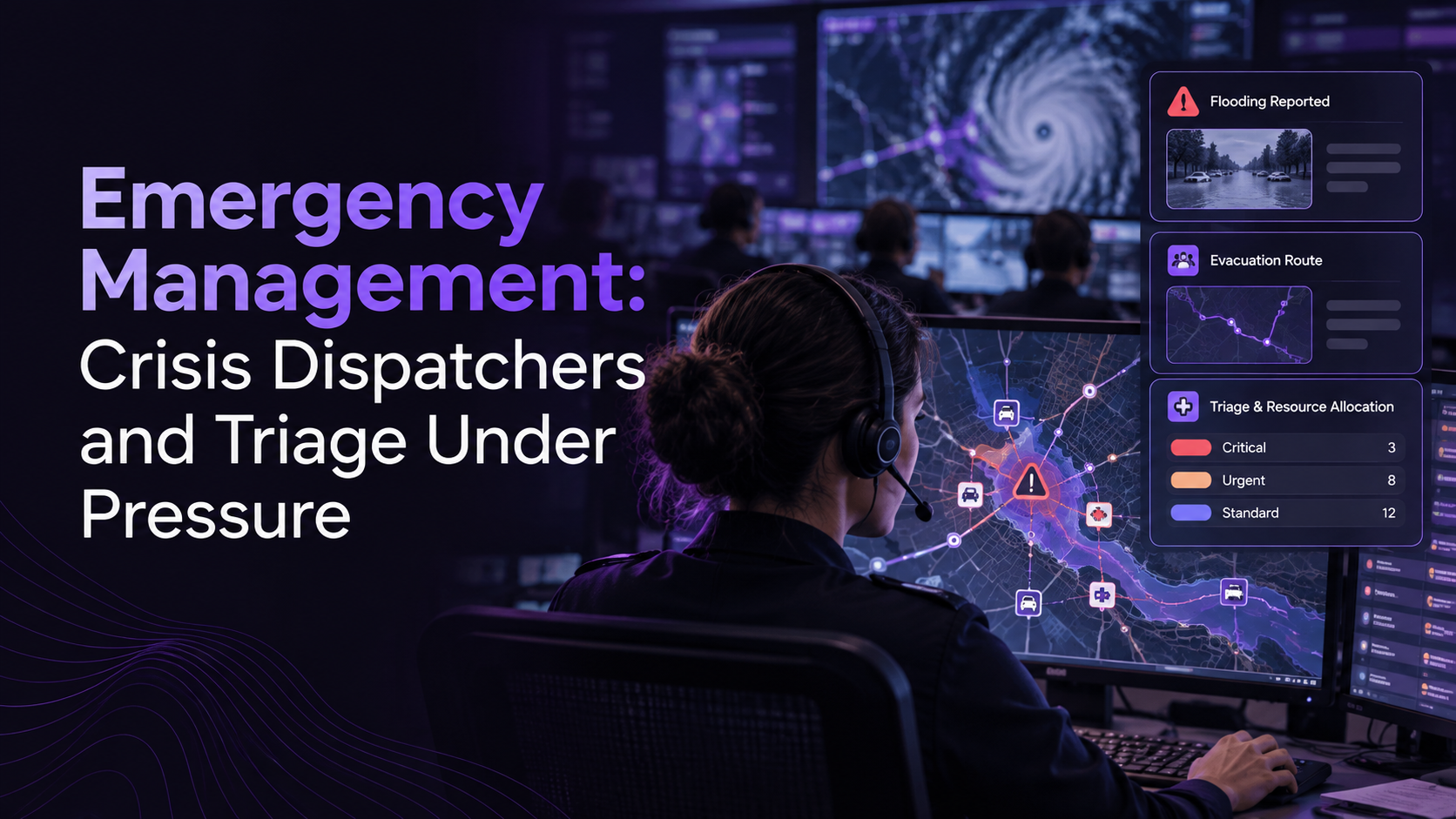
A written exam can ask a student to list the functions of the Incident Command System. It cannot tell you whether that student will remember them when three people are talking at once, a report from the field contradicts the one before it, and the clock keeps running.
That gap is the central difficulty of teaching emergency management. The work is decision-making under time pressure with partial information, and the usual assessment tools (multiple choice, policy essays, written plans) reward the opposite conditions: time, completeness, and hindsight.
Live tabletop exercises are the right answer, and programs that can run them should. The problem is cost. A good tabletop takes weeks of coordination, a facilitator for each group, and a room full of people who all have other jobs. Most students get one or two per degree.
AI branching scenarios are a way to add repetitions between the big exercises. They are not a replacement for the tabletop. They are the drills you do so the tabletop goes better.
What makes a crisis hard to teach
In a real incident, the conditions change while you are deciding.
Take a hospital losing power during a winter storm. In the first ten minutes the questions are simple: which units are on generator, which aren't, and how long do the fuel and the ventilator batteries last? Twenty minutes later the roads are worse, a second facility is calling for help, and the first answer you gave is already out of date. An early decision to evacuate may be right, or may put patients in ambulances that can't get through snow.
Three things are difficult to reproduce in a classroom:
Escalation. Delay has compounding cost. A case study hands the student the whole timeline at once, so they never feel it.
Fragmented information. Dispatchers, nurses, public works supervisors, and elected officials all report in different formats, at different levels of urgency, with different gaps. Part of the skill is deciding what you still don't know.
Plain communication under stress. NIMS emphasizes plain language and common terminology, partly because mixed codes and jargon cause confusion between agencies. Saying a clear order out loud, with a unit, a location, and a time, is a skill that improves with practice.
What a branching scenario looks like
Rocketproof's scenario workflow lets the instructor define a situation, a set of roles the student will interact with, and the ways the situation changes depending on what the student does.
Here is an example of one an emergency management instructor might build.
The situation. A severe winter storm has caused a grid failure across a regional hospital network. One hospital has lost its primary generator. Backup battery systems on its ventilators have limited runtime. Roads are partially blocked.
The student's role. Incident commander for the first ninety minutes.
The voices. A charge nurse reporting equipment failures, a 911 dispatcher relaying calls from the surrounding neighborhood, and a public works supervisor who knows which routes are passable and how long plows will take. Each speaks differently. The nurse is fast and frightened. The dispatcher is clipped. The supervisor is calm and keeps asking what the priority is.
The branches. The student's choices change what happens next:
- If the student orders a full evacuation right away without confirming transit routes, ambulances get stuck and patient condition worsens while they wait. The scenario can then ask the student to recover.
- If the student prioritizes the ventilator patients first, requests generator support, and asks for state transport help, conditions stabilize and new problems appear elsewhere, such as the shelter that is running out of power.
- If the student asks the public works supervisor a direct question about road clearance, they get a useful answer. If they never ask, they don't.
The student speaks into their microphone. They have to say the order, not choose it from a list, and the voices respond in real time.
Building one without software skills
Faculty author the scenario in the Assignment Creator, which drafts from a description that the instructor then edits. A solid disaster scenario usually needs these elements.
An incident brief. Hazard, location, weather, resources available, and any mutual aid agreements. The more concrete this is, the better the scenario runs. A real county map and a real list of facilities beats a generic "city."
Decision points. The two or three moments where the path forks. Think about where students typically go wrong and put a branch there.
Role personas. Who is talking, how they report, and what they know. A dispatcher who doesn't know about the generator failure can't mention it.
A rubric tied to your framework. If your program teaches NIMS and ICS, grade against them: clear objectives, appropriate span of control, resource prioritization, communication clarity, situational awareness. If you use HICS for hospital scenarios, name it. For exercise design, many programs align with the Homeland Security Exercise and Evaluation Program (HSEEP), which gives you language for objectives and evaluation.
You can see more examples of how programs use this on the emergency management solutions page.
Repeating the drill is the point
A single run of a scenario shows you one path. Running it again, with a different approach, shows you the shape of the problem.
A student who evacuated immediately the first time can try the opposite approach, and compare the two transcripts. They learn that neither answer is right in isolation and that the correct answer depends on information they had to ask for. That is a deeper lesson than any one scenario can deliver.
Faculty can run the same scenario as ungraded practice first, then as a graded run with a time limit. Practice recordings stay with the student, which makes it safer to try a risky decision just to see what happens.
Debriefing the decision trail
After each run, the transcript becomes the debrief document. Some questions worth asking:
- What did you do in the first five minutes, and what information did you have then?
- Which question did you not ask that would have changed your decision?
- When the nurse reported the battery failures, how did you restate the priority?
- Was your communication clear enough that a unit receiving it would know exactly what to do?
Because the record is timestamped, you can ask about specific moments, and students can review them in advance. After-action reviews in the field work much the same way: reconstruct what happened, what was expected, what actually occurred, and why.
Rocketproof drafts a rubric evaluation citing specific moments. The instructor reviews, edits, and assigns the grade.
A sample class sequence
Here is one way to fit this into a week without adding much grading load.
- Before class. Students run the scenario once in practice mode and write down two decisions they would change.
- In class. Spend twenty minutes on a short briefing about the framework you want applied, such as ICS functions or hospital incident command roles. Then show two anonymized transcript excerpts, one where the student asked a clarifying question and one where they didn't, and discuss the difference.
- After class. Students run the scenario again, this time graded, and submit a short written after-action review that cites their own timestamps.
The first run is exploration, the second is performance, and the review ties them together. Students who actually did the first run usually produce noticeably better second runs, which is a nice thing to be able to show them.
Where this fits and where it doesn't
An AI scenario does not replicate the physical environment, the noise, or the interagency politics of a real incident, and it can't stand in for a field exercise or an experienced facilitator. The consequences it simulates are only as good as the scenario you wrote. Test each one yourself, push on the edges, and fix any branch that behaves unrealistically before students see it.
Used well, it fills a gap: more repetitions of the thing that is hardest to practice, which is deciding clearly while the situation keeps changing.
Getting started
Start with an incident you already use in class. Identify the decision that most students get wrong, and make that the first branch. Build it in the AI simulation platform, run it yourself with the microphone on, and see whether the voices sound like the people you have worked with. Then assign it as ungraded practice and read a few transcripts.
If you want to pair scenario work with a graded spoken assessment, look at the oral defense platform. For a related approach in clinical education, read our post on AI patient simulations for nursing students.
Questions emergency management faculty ask
Does this replace a tabletop exercise? No. A tabletop brings multiple people and agencies into one room, and that coordination is part of what you are teaching. The AI scenario gives individual students practice before they get there.
How realistic are the voices? Realistic enough to practice clear communication, not realistic enough to mistake for a live radio net. Tune each persona's pacing and emotional state, and listen to a full run before assigning it.
Can I base a scenario on a real local incident? Yes, and it tends to work well, because students can compare their choices with what actually happened. Strip out anything sensitive or personally identifying first.
What if a student takes a path I did not plan for? It will happen. The scenario should respond sensibly, and where it doesn't, that is a note for the next revision. Reading a few transcripts after the first cohort usually shows you where the branches need work.
Is it only for emergency management? No. Public health, criminal justice, hospital administration, and aviation programs have similar problems: fast decisions, partial information, and consequences that build.
See Rocketproof in action
Explore the interactive demo as a student and an instructor, or request a pilot for your department.