
AI Patient Simulations for Nursing Students
How nursing faculty use AI patient simulations to give every student repeated practice at intake interviews, symptom discovery, and bedside communication, with no programming.
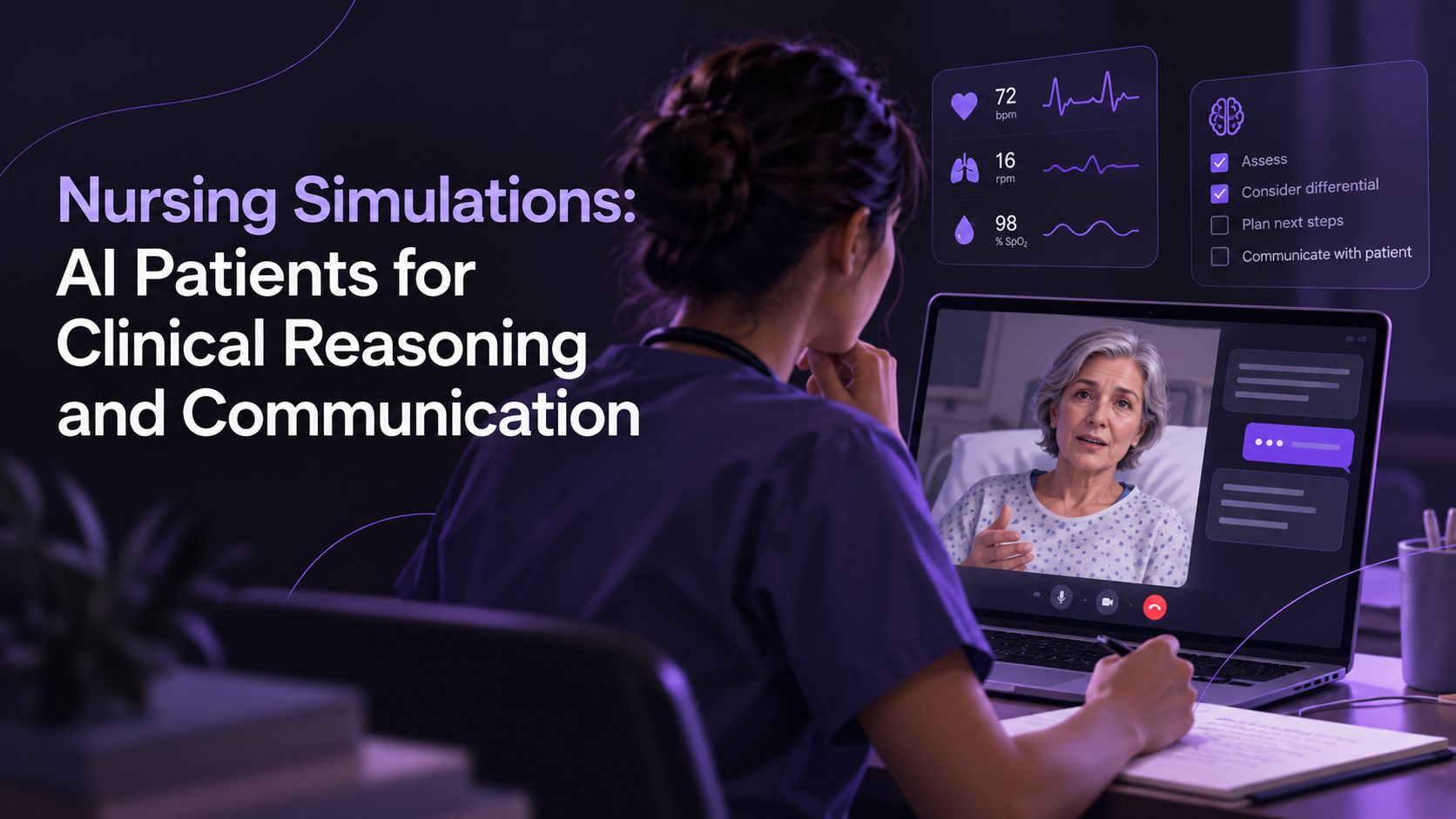
Ask a nursing instructor what limits simulation in their program and the answer is almost never "we don't believe in it." It's scheduling. A high-fidelity mannequin needs a lab, a technician, a faculty member in the control room, and a cohort that can all be in the same building at the same time. Most students end up with a handful of sim hours a term, and a good chunk of that is spent waiting for a turn.
Mannequins are also built for a particular kind of learning. They are excellent for procedures: the IV start, the rhythm change, compressions that actually need to be deep enough. They are much weaker at the part of nursing that happens before any procedure, which is getting a frightened person to tell you what is really going on.
That second skill is where an AI patient fits. It does not replace the lab. It covers the conversation the lab was never designed to hold.
What students get wrong in the interview
Students usually arrive at their first intake with a checklist: onset, location, duration, character, and so on (many programs teach this as OLDCARTS or PQRST). The checklist is a good floor. The trouble is that real patients don't answer it in order, and some don't answer it honestly.
A few patterns come up again and again in nursing education literature and in any clinical instructor's war stories:
- Patients minimize. "It's probably just heartburn" is one of the most common things people say on the way into an emergency department with an acute coronary syndrome, and presentations in women, older adults, and people with diabetes are often less textbook than students expect.
- Patients hold things back. Missed medication doses, alcohol use, and a family history that feels embarrassing to mention all tend to surface only when someone asks a direct, unhurried question.
- Patients are scared, and fear changes how they talk. Short answers, jokes, and sudden changes of subject are often signals, not noise.
A student can read about all of this and still freeze when a real person gives a one-word answer. The fix is repetition with a partner who behaves like a patient. Peer role-play helps, but classmates tend to break character, take pity, and volunteer information that a real patient would not.
What an AI patient interview looks like
In Rocketproof, the student talks to the patient out loud or by text. The patient is a persona the instructor wrote, with a chief complaint, a manner of speaking, and facts they will only reveal under the right questioning.
Here is a cardiovascular intake the way a faculty member might build it.
The patient is Arthur, 58, a retired school administrator who doesn't like hospitals. He came in because his wife insisted. He tells everyone the pressure in his chest is heartburn from lunch.
The instructor gives Arthur three rules:
- He answers the question asked and nothing more.
- He downplays anything that sounds serious until the student asks about it specifically.
- He reveals two hidden facts only on direct questioning: the discomfort gets worse when he climbs stairs, and his brother had a heart attack at 60.
If the student opens with "How are you feeling?", Arthur says "Fine, honestly. Just a bit of indigestion." If the student asks "Does anything make it worse, like walking or stairs?", Arthur pauses and admits he had to stop halfway up the stairs at home yesterday. If the student never asks about family history, the brother never comes up, and that shows in the transcript and the rubric.
The interesting part is the second pass. A student who failed to surface the family history on the first attempt can run Arthur again tomorrow and try a different approach. Arthur is the same patient with the same constraints. The only thing that changed is the student.
Building a case without prompt engineering
None of this requires faculty to write code or craft clever prompts. The Assignment Creator takes a plain description and drafts the scenario, the patient's behavior rules, and a rubric. The instructor edits the draft rather than starting from a blank page. A good case usually has four parts:
The clinical brief. Age, presenting complaint, relevant history, current medications, and vitals. This is the ground truth the patient is not allowed to contradict.
The behavioral rules. How the patient talks and what they will and won't volunteer. This is where most of the teaching value lives, so it is worth spending time on. "Anxious and terse" produces a very different encounter from "chatty and apologetic."
The learning objectives. What the student has to accomplish. Identify likely differentials, ask about cardiac risk factors, recognize that this patient needs escalation. Be specific, because the rubric will be built from these.
The rubric. Criteria the instructor can defend: accuracy of the assessment, quality of questions, communication and empathy, and whether the student recognized urgency. If your program uses SBAR for handoff, add a criterion for how the student summarizes the case to the provider at the end.
Instructors who want inspiration can start from the nursing solutions page and adapt a case to their own course.
Practice first, graded second
A graded interview with no chance to rehearse mostly measures who is already comfortable talking to strangers. Rocketproof separates practice from graded work so students can fail privately before they are evaluated.
In practice mode, students can run the same patient as many times as they like. Their recordings and transcripts stay with them. Faculty can set a required amount of practice that has to be completed before the graded attempt unlocks, so that nobody walks into the graded session cold.
The graded attempt runs under the conditions the instructor sets, including a time limit. Rocketproof drafts rubric scores that point to specific moments in the transcript. The instructor of record reads the evidence, changes anything they disagree with, and finalizes the grade. The AI does not issue the grade.
Debriefing is where the learning sticks
Simulation researchers have said for years that the scenario itself is only half the lesson. The structured conversation afterward is the other half, and the INACSL Healthcare Simulation Standards of Best Practice treat debriefing as a core standard for exactly that reason.
A timestamped transcript makes debriefs concrete. Instead of "I think you rushed the pain assessment," a faculty member can point to the exact minute and ask what the student was thinking. Useful prompts include:
- Where did the patient give you a cue you didn't follow up on?
- What did you assume about Arthur's answer when he said "indigestion"?
- When he went quiet, what did you do?
Students can also review their own transcript before the debrief, which tends to produce better conversation than a cold start.
What this does not do
It is worth saying plainly what an AI patient can't do. It can't teach you to read skin color, palpate an abdomen, or notice the smell of a wound. It doesn't replace clinical placements, and it shouldn't be the only communication practice a program offers. It is also a model, which means faculty should play through a new case themselves before assigning it, the same way they would pilot any new simulation.
What it does well is give every student, not just the ones who got a lab slot, a place to practice the awkward first five minutes of a patient encounter as many times as they need.
Getting started
If you teach nursing and want to try one, start small. Pick a single presentation you already use in class, write the patient's hidden facts down on paper, and build the case in the AI simulation platform. Run it yourself first. Then assign it as ungraded practice and read a few transcripts before you decide how to grade it.
For the oral-assessment side of the same idea, see how the oral defense platform handles graded, recorded conversations, and for a different discipline's take on the same method, read our post on crisis dispatch simulations in emergency management.
A sample rubric
A short rubric keeps grading consistent and gives students something to aim at. For an intake interview, a faculty member might score each of the following on a four-point scale:
- Opens the encounter appropriately (introduction, purpose, consent to proceed)
- Elicits the chief complaint in the patient's own words before narrowing down
- Asks about onset, character, aggravating and relieving factors, and associated symptoms
- Explores risk factors and relevant family and medication history
- Responds to emotional cues, such as fear or minimization, rather than moving past them
- Recognizes the need for escalation and communicates it clearly
Weighting the response to emotional cues as heavily as the checklist items tends to change how students prepare.
Questions nursing faculty ask
Does an AI patient replace the simulation lab? No. Mannequins and standardized patients teach things an AI conversation can't, like physical assessment and procedures. The AI patient adds more repetitions of the conversation itself, which labs rarely have time for.
Will the patient say something clinically wrong? It can, which is why the clinical brief matters. The patient is told what is true about their condition and is not supposed to go beyond it. Play the case through yourself first and tighten anything that drifts.
How long does a case take to build? A first case usually takes under an hour if you already have a presentation you teach. The second one is faster, because you reuse the structure and only change the patient.
Can students use it on their own time? Yes. That is most of the value. A student can run the interview at 10 p.m. before a clinical day, with no lab booking and nobody watching.
What about students who are nervous about being recorded? Practice recordings stay private to the student. Say that clearly at the start of the course, because it changes how willing they are to try risky questions.
See Rocketproof in action
Explore the interactive demo as a student and an instructor, or request a pilot for your department.